A new book by Remko Deenik
Recompose the Work
Why Better Organization Design Beats Better AI Models
AI makes tasks faster. It does not fix the work between them.
The central argument
The biggest delays are no longer inside tasks. They live between them.
Faster tools improve individual output. They do not resolve slow handoffs, unclear authority, brittle policies, or judgment that remains unwritten.
The advantage belongs to the organization that can redesign how it works faster than the market changes what it demands.
A method for adaptability
Start with the work, not the tool.
01 / CAPABILITIES
Define what the organization must be able to do.
Begin with outcomes and enduring capabilities before choosing systems, roles, or models.
02 / CONTRACTS
Make functions explicit and composable.
Clarify authority, policy, information, inputs, outputs, and the exceptions that teach the system.
03 / AUTONOMY API
Put judgment where the work happens.
Hand work to people and AI through clear boundaries that make autonomy safer and learning reusable.
Ideas in motion
Current thinking
-
Part 5 of 5: Advantage is a rate, not a position
Durable advantage is not the position you hold today. It is how quickly your organization can field the next answer when the…
-
Part 4 of 5: The Autonomy API—the three things an agent needs before you can trust it to decide
Autonomous work needs three things at once: the right to decide, a rule to decide by, and the facts the decision needs.
-
Part 3 of 5: Your AI has read everything and knows nothing about you
An AI agent arrives with world-class general knowledge and zero local knowledge. That makes it a merciless test of whether you can…
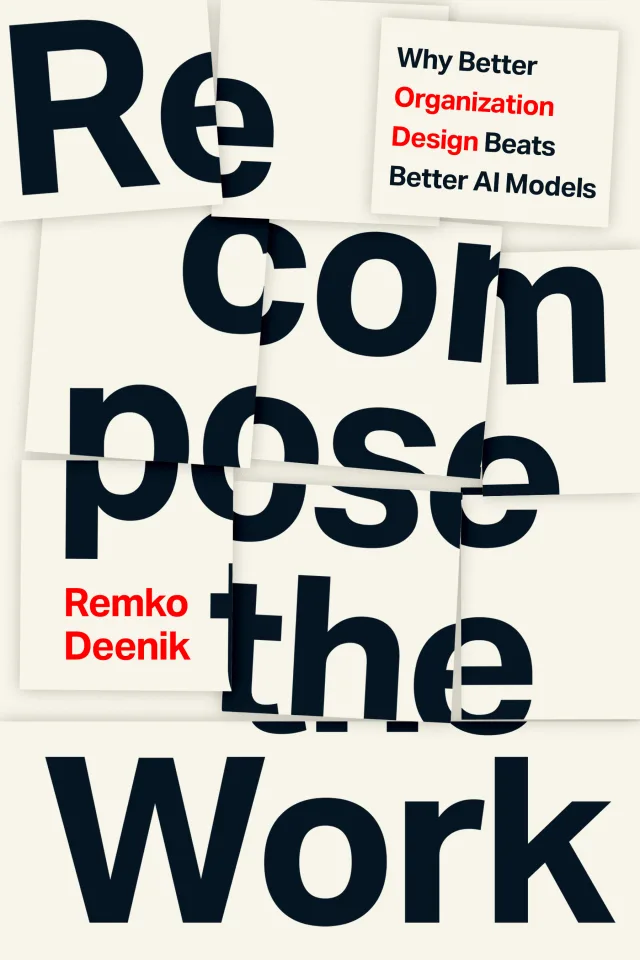
The book
Recompose the Work
Why Better Organization Design Beats Better AI Models
AI adoption is becoming table stakes. This book offers a practical method, built around the Autonomy API, for making organizations explicit, adaptable, and ready to put intelligence to work.
For senior leaders at established companies who want AI to change how the business works, not only how fast individuals work.
Speaking
I work with leadership teams on what has to change in the organization before AI changes anything in the results.
- Why better models do not fix broken operating systems
- Designing authority for human and machine judgment
- What leaders must make explicit before scaling AI

Get in touch
Contact
For speaking, press, rights, or other inquiries, use the form below.